Las Cruces Yard Guide
Caliche Soil in Las Cruces: What It Is and How to Plant Through It
You dig a foot down and hit something that feels like concrete. That’s caliche, and it’s behind a lot of the yellow, stunted and blown-over trees in Las Cruces yards. Here’s what it is, how to tell if you have it, and the planting-hole sizes NMSU recommends to get roots through it.
Updated October 2026 using NMSU Extension Guide A-151, “Growing Plants in Caliche Soils.”
Quick answer
What is caliche soil, and why does it matter?
Caliche soil is a hard, whitish layer cemented by calcium and magnesium carbonates, common in Las Cruces yards. It blocks drainage so planting holes flood, stops roots so trees stay shallow and blow over, and keeps soil alkaline at pH 7.5 to 8.5, which causes yellow leaves.
It forms in dry climates when rainwater carries dissolved carbonates down into the soil and leaves them behind as it evaporates. It can be soft or rock-hard, and sit anywhere from a few inches to several feet down.
Signs you have caliche
Three problems
How does caliche hurt plants and trees?
Caliche hurts plants three ways: water sits in planting holes instead of draining, so roots rot; roots hit the hard layer and turn sideways, so trees dry out and blow over; and the alkaline soil locks up iron and other nutrients, causing yellow leaves.
Poor drainage
Caliche can soak up water, but it doesn’t let it flow through quickly. Water sits in the planting hole, roots rot, and drip-watered trees drown slowly.
Shallow roots
Roots hit the hard layer and turn sideways. Trees with shallow, spreading roots dry out faster in summer and are more likely to blow over in monsoon wind.
Yellow leaves
At pH 7.5 to 8.5, iron, zinc, manganese, boron and phosphorus become hard for plants to take up. Iron chlorosis (yellow leaves with green veins) is the most common sign.
Source: NMSU Extension Guide A-151, “Growing Plants in Caliche Soils.” Most plants prefer a pH of 6.0 to 7.0.
Test first
How do I know if my yard has caliche?
Dig a test hole two to three feet deep where you plan to plant and look for a white or cream cemented layer. Then fill it with water: if it drains slower than one inch per hour, caliche or another hard layer is blocking drainage.
|
Method |
How |
What it tells you |
|---|---|---|
|
Dig a test hole |
Dig where you plan to plant, 2 to 3 feet if you can |
Whether and how deep the hard layer is |
|
Drainage test |
Fill the hole with water, let it drain, refill and time it |
Needs to drain at least 1 inch per hour |
|
Web Soil Survey |
Look up your address on the USDA Web Soil Survey |
Your soil series and typical caliche depth |
|
Look for white |
Check the hole walls and bottom |
A white or cream cemented layer is caliche |
Drainage rate and Web Soil Survey tip from NMSU Guide A-151. Depth varies a lot: NMSU lists New Mexico soil series with caliche from 4 inches to more than 6 feet down.
Planting
How big should a planting hole be in caliche?
NMSU recommends digging through the caliche, not just into it: about 3 feet deep and 2 to 3 feet wide for shrubs, 5 feet deep and 6 feet wide for small trees, and 6 feet deep and 8 feet wide for large trees.
|
What you’re planting |
Hole depth |
Hole width |
|---|---|---|
|
Flower beds |
2 ft |
0.5 ft |
|
Small shrubs |
3 ft |
2 ft |
|
Large shrubs |
3 ft |
3 ft |
|
Small trees |
5 ft |
6 ft |
|
Large trees |
6 ft |
8 ft |
Source: NMSU Extension Guide A-151. Backfill with good soil containing 2 to 4% organic matter; for sandy or heavy clay soils, NMSU suggests about 1 part compost to 4 parts soil.
Step by step
How do you plant a tree in caliche?
Call 811 and check septic lines first, then break through the caliche with a digging bar, jackhammer or powered auger, test that the hole drains at least one inch per hour, backfill with good soil and set drip emitters toward the edge of the hole.
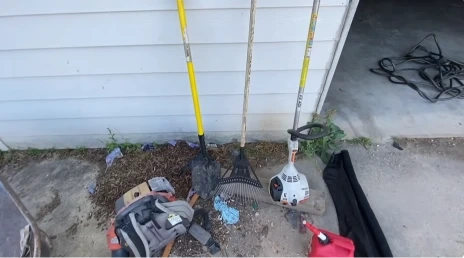
Tools laid out before a bed refresh. Caliche digging often needs heavier equipment.
Fixes
How do you fix caliche problems in a yard?
Dig through the layer instead of adding gravel, choose plants adapted to alkaline soil, treat iron chlorosis with iron products made for high-pH soil, water deeply and less often, and build raised or mounded beds where caliche lies under a whole bed.
|
Problem |
What helps |
What doesn’t |
|---|---|---|
|
Water standing in planting holes |
Dig through the layer; drainage test before planting |
Adding gravel to the bottom of the hole |
|
Yellow leaves (iron chlorosis) |
Plants adapted to alkaline soil; iron products made for high-pH soil, used per the label |
More water or regular fertilizer |
|
Stunted, shallow-rooted trees |
Wide planting areas; deep, infrequent drip watering |
Frequent shallow watering |
|
Hard layer under a whole bed |
Raised or mounded beds with good soil |
Tilling the top few inches |
|
Thin caliche over a large area |
Deep ripping, if the layer is thin and not too hard |
Ripping thick, hard caliche (impractical) |
Deep ripping guidance from NMSU Guide A-151.
Plant choice
What plants grow well in caliche soil?
Desert-adapted plants handle alkaline caliche soil best, including desert willow, Texas sage, Apache plume, fourwing saltbush, red yucca, creosote bush, blackfoot daisy and desert marigold. Azaleas, gardenias and pin oaks usually struggle with the high pH.
Already seeing yellow leaves? Read our guide to iron chlorosis in Las Cruces.
Related services and guides
Caliche FAQs
Hit caliche? We’ll dig through it
We plant trees and shrubs the right way in Las Cruces caliche, with drainage tested before anything goes in. Free, written estimate.
Las Cruces Landscaping Group
1921 Santa Ines Drive, Las Cruces, NM 88011
(575) 270-0676. Mon to Sat, 7 a.m. to 7 p.m.
Request a Free Estimate
Takes under a minute. We’ll call you back today.