
Xeriscaping & Desert Landscaping
Xeriscaping in Las Cruces, NM: Water-Smart Desert Yards That Still Look Alive
Tired of paying to water a Bermuda lawn that’s brown half the year? We turn thirsty lawns and bare dirt into desert landscapes built for Zone 8b: native plants on drip, rock that stays put through monsoon storms, and a weed plan so your yard doesn’t turn into a goathead patch.
Most xeriscape conversions in Las Cruces run $8 to $20 per square foot. Free on-site estimate and layout sketch.
Quick answer
What is xeriscaping, and what does it cost in Las Cruces?
Xeriscaping is landscaping designed to need little or no extra water. In Las Cruces that means native and desert-adapted plants, drip irrigation instead of spray heads, and rock or mulch instead of thirsty turf. Most conversions cost $8 to $20 per square foot installed.
Xeriscaping in Las Cruces typically costs $8 to $20 per square foot installed. A 500 sq ft front yard usually lands between $4,000 and $10,000. Where you fall depends on how much lawn we remove, the rock you pick, plant sizes, boulders and how many drip zones you need.
Xeriscaping is a good fit if…
Not ready to lose all your grass? We often keep one small lawn or turf area for kids and dogs and xeriscape the rest.
What’s included
What does a Las Cruces xeriscape conversion include?
A complete xeriscape conversion includes removing turf and roots, fixing the grade so water drains away from the house, laying commercial weed barrier, installing drip irrigation with a smart controller, planting desert-adapted plants and spreading rock or mulch at the right depth.
Lawn and weed removal
We strip old Bermuda sod and roots, treat regrowth, and haul it away. Skipping this step is why many rock yards sprout grass within a year.
Grading for monsoon storms
We slope soil away from your foundation and plan where storm water goes, using dry creek beds or basins that let plants drink it.
Drip irrigation zones
Trees, shrubs and cacti get separate drip zones, because a mesquite and an agave should never run on the same schedule.
Native and desert plants
Blue grama, desert willow, red yucca, Texas sage, globemallow and more, grouped in masses so the yard looks designed, not random.
Rock, gravel and boulders
Santa Fe brown, crushed granite or river rock at 2 to 3 inches deep over a permeable weed barrier, with boulders for structure.
Steel edging and clean lines
Edging keeps rock out of paths and DG in place, so the yard still looks sharp after the first big storm.
2026 price guide
How much does xeriscaping cost in Las Cruces?
Xeriscaping in Las Cruces usually costs $8 to $20 per square foot installed, so a 500 square foot front yard runs about $4,000 to $10,000. Turf removal, drip irrigation, plant size and the type of rock or hardscape drive where your price lands.
|
Item |
Typical installed cost |
Notes |
|---|---|---|
|
Whole-yard conversion |
$8 to $20 per sq ft |
Most Las Cruces yards fall in the middle of this range |
|
Lawn and sod removal |
$1 to $2 per sq ft |
Includes haul-off; more if roots are deep |
|
Weed barrier + landscape rock |
$3 to $6 per sq ft |
Rock type, depth and delivery distance |
|
Crushed granite (DG) paths |
$3 to $6 per sq ft |
Stabilized DG costs more but holds up to storms |
|
$800 to $3,000 |
Number of zones, plant count, smart controller |
|
|
Plants, 1-gallon |
$12 to $30 each |
Groundcovers, grasses, perennials |
|
Plants, 5-gallon |
$30 to $90 each |
Shrubs, agaves, yuccas |
|
Trees, 15-gallon |
$100 to $300 each |
Desert willow, mesquite, palo verde |
|
Boulders |
$200 to $800 each |
Size, and whether equipment is needed |
|
Steel edging |
$6 to $15 per linear ft |
Steel lasts longest in our sun |
|
Debris haul-off |
$200 to $500 |
Old rock, sod and roots |
Ranges based on 2026 national cost data (Angi, Lawn Love, HomeGuide), adjusted for Las Cruces. Your price is set in writing after the site visit.
Cost by yard size
|
Area |
Typical total |
|---|---|
|
250 sq ft |
$2,000 to $5,000 |
|
500 sq ft |
$4,000 to $10,000 |
|
1,000 sq ft |
$8,000 to $20,000 |
|
2,500 sq ft |
$20,000 to $50,000 |
A typical front-yard conversion
Example: an 800 sq ft Bermuda front lawn in Sonoma Ranch. Sod removal ($800–$1,600), weed barrier and Santa Fe brown rock ($2,400–$4,800), a two-zone drip system ($1,000–$1,800), about 15 desert plants and one desert willow ($500–$1,200), and steel edging ($600–$1,200). That comes to roughly $5,300 to $10,600, and no more mowing.
Illustration of how we price. Your yard and total will differ.
Compare your options
Is xeriscape, Bermuda lawn or artificial turf better in Las Cruces?
Xeriscape uses the least water and needs the least care, so it fits most Las Cruces yards. Bermuda lawn is cheapest to install but needs summer water and mowing, and artificial turf costs the most upfront but stays green with no watering at all.
|
Xeriscape |
Bermuda lawn |
Artificial turf |
|
|---|---|---|---|
|
Upfront cost |
$8 to $20 per sq ft |
$1 to $2 per sq ft for sod |
$8 to $16 per sq ft |
|
Water use |
Very low (drip only) |
High, all summer |
None, except rinsing |
|
Upkeep |
Weeding, pruning, drip checks |
Mowing, fertilizing, watering |
Brushing, infill, rinsing pet areas |
|
Summer surface heat |
Rock warms; plants and shade cool it |
Coolest underfoot |
Can get very hot in full sun |
|
Winter look |
Evergreen natives and rock |
Dormant tan |
Green all year |
|
Monsoon storms |
Handles runoff when graded well |
Absorbs water |
Needs good drainage base |
How much water does xeriscaping save?
Most of the savings come from two changes: removing thirsty turf and replacing spray heads with drip. Las Cruces Utilities says as much as 50 percent of outdoor water is wasted by inefficient watering, and NMSU research found drip irrigation used 30 to 50 percent less water than pop-up sprinklers on turf. A well-built xeriscape that replaces a lawn usually cuts outdoor use even further.
Myth vs. fact
“Xeriscape means zero maintenance.”
Fact: it’s low-water and lower-maintenance, not no-maintenance. Rock beds still need weed control, shrubs need a yearly trim, and drip emitters need a check each season.
Myth vs. fact
“Desert yards are just rock.”
Fact: the best xeriscapes are mostly plants. Native grasses, shrubs, cacti and one or two shade trees cool the yard and bring in bees, hummingbirds and butterflies.
How it works
How do you design and install a xeriscape?
We follow NMSU Extension’s seven xeriscape principles: plan the design, improve the soil where needed, limit turf, choose desert-adapted plants, irrigate efficiently with drip, mulch the surface and maintain it, all adapted to caliche, alkaline soil and monsoon runoff.
1
Site visit
We check sun, soil and caliche, drainage, HOA rules and how you want to use the yard.
2
Layout and quote
A sketch with water zones and plant groups, plus an itemized written price.
3
Prep
Lawn removed, soil graded away from the house, planting holes opened through caliche.
4
Install
Drip first, then plants, weed barrier, rock and edging. We work back to front.
Plant palette
What plants are best for a Las Cruces xeriscape?
The best xeriscape plants for Las Cruces handle 100-degree summers, winter freezes and alkaline soil, such as desert willow, Texas sage, red yucca, agave, salvia, blackfoot daisy, desert marigold and native grasses. Group them by water need so drip zones stay efficient.
See desert-style beds, rock borders and drip installs in our landscaping photo gallery.
|
Plant |
Type |
Water once established |
Why we use it |
|---|---|---|---|
|
Blue grama (Bouteloua gracilis) |
Native grass |
Very low |
New Mexico’s state grass; soft, fine texture |
|
Sideoats grama |
Native grass |
Very low |
Bunch grass with seed heads that move in the wind |
|
Desert willow (Chilopsis linearis) |
Small tree |
Low |
Orchid-like summer flowers, light shade |
|
Red yucca (Hesperaloe parviflora) |
Accent |
Very low |
Coral flower spikes that hummingbirds love |
|
Parry’s agave |
Succulent |
Very low |
Bold focal point; handles cold snaps |
|
Texas sage (Leucophyllum) |
Shrub |
Low |
Silver leaves, purple blooms after rain |
|
Apache plume |
Native shrub |
Low |
Feathery pink seed heads, tough in wind |
|
Globemallow |
Native perennial |
Very low |
Orange flowers spring to fall |
|
Desert marigold |
Native perennial |
Very low |
Bright yellow color almost all year |
|
Blackfoot daisy |
Native groundcover |
Very low |
Low white mounds for bed edges |
For more local plant lists, see NMSU Doña Ana County Extension or visit the City’s Demonstration Garden at 618 N. Motel Blvd.
Designing with three water zones
NMSU recommends grouping plants into water zones, called hydrozones. It’s the single biggest reason our yards use so little water.
|
Zone |
Where it goes |
Watering |
|---|---|---|
|
Oasis |
Patio, entry, seating areas |
Most water, most color |
|
Transition |
Between patio and yard edge |
Moderate, less often |
|
Low-water |
Outer yard, slopes, side yards |
Little to none once established |
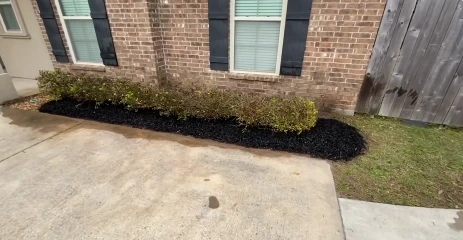
Tip: organic mulch in planting wells keeps roots cooler than rock right next to the plant.
Local know-how
What goes wrong with xeriscapes in Las Cruces?
Most failed Las Cruces xeriscapes trace back to cheap weed barrier, rock laid too thin, plants set into caliche without wide holes, drip left on lawn schedules, and grading that sends monsoon water toward the house. We plan around each one on every job.
Caliche
That cement-hard layer blocks roots and drainage. We break through it in every planting hole so trees don’t drown or stall.
Monsoon washouts
July to September storms can move rock downhill. We grade, use larger rock in water paths, and add dry creek beds where needed.
Goatheads and weeds
A permeable weed barrier, 2 to 3 inches of rock and a late-winter pre-emergent keep goatheads and grass from coming back.
Reflected heat
West and south walls cook plants. We put the toughest species there and place a shade tree where it cools the house.
HOA approval
We design within your HOA’s plant list and rock colors and prepare the drawing your committee asks for.
Rainwater harvesting
Collecting rainwater from your roof is legal in New Mexico. We can route downspouts to basins or add a cistern.
Service area
Where do you install xeriscapes near Las Cruces?
We design and install xeriscapes throughout Las Cruces, Mesilla, University Park, Doña Ana, Fairacres, Organ and Talavera, from older Mesilla Valley lots with mature trees to new builds in Metro Verde, Sonoma Ranch and Picacho Hills. Estimates are free and written.
Why homeowners choose us
Related services
Xeriscaping FAQs
Ready for a yard that doesn’t drink your water bill?
Tell us about your yard. We’ll come out, sketch a water-smart layout and give you a written price, with no pressure to commit.
Las Cruces Landscaping Group
1921 Santa Ines Drive, Las Cruces, NM 88011
(575) 270-0676. Mon to Sat, 7 a.m. to 7 p.m.
Request a Free Estimate
Takes under a minute. We’ll call you back today.