Las Cruces Yard Guide
Dry Creek Bed Ideas and Costs for Las Cruces
A dry creek bed is a rock-lined channel that carries monsoon runoff away from your house and looks like a natural arroyo the rest of the year. Done right, it solves a drainage problem and becomes the best-looking part of a desert yard. Here’s what one costs and how to build it so it works.
Updated September 2026. Costs match our 2026 Las Cruces drainage and rock pricing.
Quick answer
How much does a dry creek bed cost in Las Cruces?
A dry creek bed in Las Cruces typically costs $20 to $50 per linear foot installed, including digging, weed barrier and river rock. A 40 foot creek running to a side-yard outlet usually costs about $800 to $2,000. Boulders, grading and caliche add to the total.
The price climbs with width, rock size, hand-placed boulders and how hard the digging is. Where the creek sends the water matters as much as how it looks.
Dry creek bed cost by length
|
Length |
Typical installed cost |
|---|---|
|
20 ft |
$400 to $1,000 |
|
40 ft |
$800 to $2,000 |
|
60 ft |
$1,200 to $3,000 |
|
100 ft |
$2,000 to $5,000 |
At $20 to $50 per linear foot. Boulders run about $200 to $800 each.
Does it work?
Does a dry creek bed actually fix drainage?
Yes, when it follows the natural low line, slopes steadily downhill, and ends at a safe outlet. A dry creek bed moves surface runoff; it won’t fix water that’s pooling because the ground slopes toward the house. That needs regrading first.
When is a dry creek the right fix?
When runoff crosses the yard, washes rock onto walks, or needs to get from downspouts or a slope to the street or a lower corner.
When isn’t it?
When water sits for days over caliche with no outlet. Then you need a dry well, a basin or a different route.
Where can the water go?
To a lower part of your yard, a planting basin, a dry well or the street where allowed. Never into a neighbor’s yard.
Build it right
How do you build a dry creek bed?
Trace the path water already takes, dig a shallow channel about twice as wide as it is deep, slope it steadily downhill, line it with permeable weed barrier, then set larger rock on the edges and bends and smaller river rock down the middle.
1
Watch a storm
Note where water actually flows and where it needs to go.
2
Mark a natural curve
Real arroyos wander. Vary the width and avoid straight lines.
3
Dig and slope
Most yard creeks are 2 to 4 feet wide and 6 to 12 inches deep, falling steadily to the outlet.
4
Line it
Lay permeable weed barrier so water drains through but soil and weeds stay put.
5
Set the big rock first
Boulders and large cobble on the outside of bends, where water hits hardest.
6
Fill with river rock
Mixed sizes down the channel look natural and slow the water.
7
Protect the outlet
A splash pad of larger rock stops erosion where the water leaves.
Materials
What rock is best for a dry creek bed?
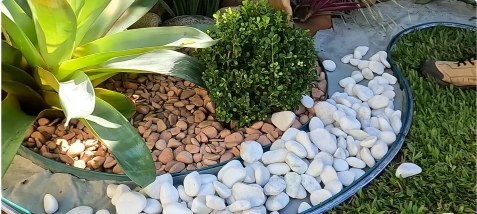
Use rounded river rock in mixed sizes: 2 to 4 inch rock down the channel, 4 to 8 inch cobble along the edges, and a few boulders at bends and the outlet. Crushed gravel alone washes out in monsoon storms.
|
Rock |
Where it goes |
Why |
|---|---|---|
|
River rock, 2 to 4 in |
Channel floor |
Looks natural, lets water through |
|
Cobble, 4 to 8 in |
Edges and banks |
Heavy enough to stay put in storms |
|
Boulders |
Bends, outlet, focal points |
Break up the flow and anchor the design |
|
Flagstone |
Stepping-stone crossings |
Lets paths cross the creek |
|
Permeable weed barrier |
Under everything |
Holds soil, blocks weeds, drains |
See colors and sizes in our best landscape rock guide and river rock page.
Ideas
What are good dry creek bed ideas for a desert yard?
The best dry creek beds in Las Cruces look like small arroyos: a curving channel of tan and brown river rock, a few boulders, a flagstone crossing, and desert plants tucked along the banks where the runoff gives them extra water.
Downspout to street
Start a narrow creek at a downspout and let it widen as it carries roof water across the front yard.
Planted banks
Edge the creek with plants that like occasional extra water, such as deergrass, desert willow, penstemon and blackfoot daisy.
Bridge or stepping stones
A flagstone crossing or small bridge turns a drainage channel into a feature people notice.
Side-yard runoff channel
A narrow creek in a muddy side yard carries water to the back and stops rock washing onto walks.
End in a basin
Finish the creek in a planting basin around a tree so storm water becomes free irrigation.
Night lighting
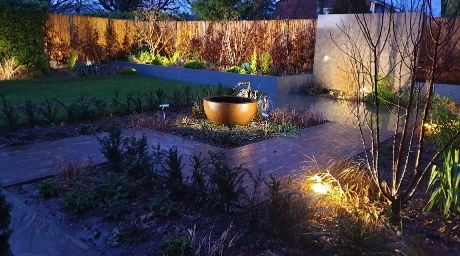
A few low-voltage lights on boulders make the creek a focal point after dark.
Mistakes
What are common dry creek bed mistakes?
The most common mistakes are a straight, even-width channel that looks fake, no real slope or outlet, rock that’s too small to stay put in a storm, plastic instead of permeable fabric, and ending the creek next to the house or a neighbor’s wall.
Getting ready for storm season? See our monsoon yard prep checklist.
Related services
Dry creek bed FAQs
Want a creek that looks good and moves water?
We design and build dry creek beds that follow your yard’s natural flow, with a written, itemized price. Free estimate.
Las Cruces Landscaping Group
1921 Santa Ines Drive, Las Cruces, NM 88011
(575) 270-0676. Mon to Sat, 7 a.m. to 7 p.m.
Request a Free Estimate
Takes under a minute. We’ll call you back today.